Why can casinos pay huge jackpots and still operate profitable businesses?
The answer is largely mathematical.
Casino games are generally structured so that the operator has an advantage over repeated play.
That advantage is commonly called the house edge.
Understanding it is one of the most important lessons for any new casino player.
What Is the House Edge?
The house edge represents the casino's theoretical mathematical advantage.
Imagine a hypothetical game with a 5% house edge.
That does not mean:
"Every €100 session loses exactly €5."
You could win €200.
You could lose €100.
You could finish almost exactly where you started.
The 5% describes expected value across repeated wagering under the game's mathematical model.
A Simple Example
Imagine a fictional coin-flip game.
You wager €1.
Heads: casino pays €0.90 profit.
Tails: you lose €1.
The probability of either outcome is 50%.
Your expected result per €1 wager is:
(0.50 × €0.90) + (0.50 × -€1)
= €0.45 - €0.50
= -€0.05.
The game therefore has an expected loss of €0.05 per €1 wager, equivalent to a 5% house advantage.
You can still win individual flips.
The disadvantage emerges mathematically through repetition.
House Edge and RTP
RTP describes theoretical return to players.
House edge describes the complementary theoretical advantage.
In simplified form:
House Edge = 100% − RTP
A 96% theoretical RTP corresponds to approximately a 4% theoretical house edge.
A 98% RTP corresponds to approximately 2%.
The terminology changes, but the concepts are closely related.
Roulette Example
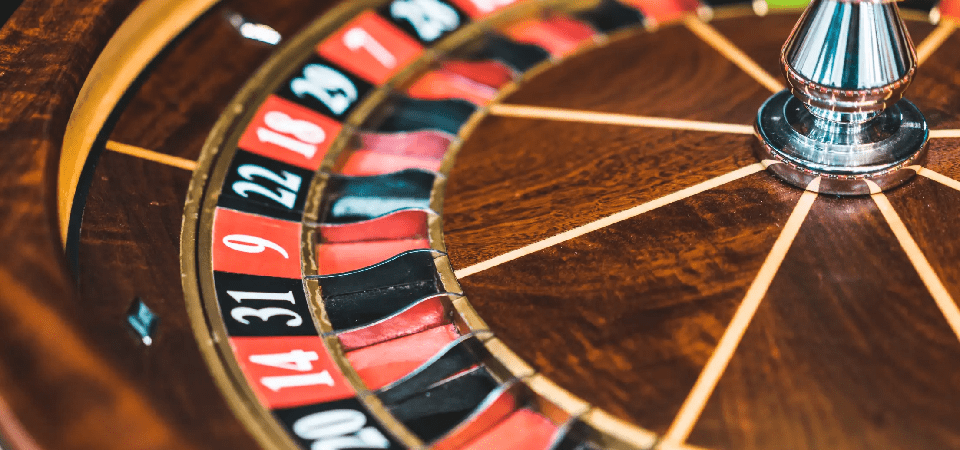
Consider a European-style roulette wheel with 37 pockets:
0 through 36.
An even-money wager such as red covers 18 numbers.
But there are 37 total outcomes because zero exists.
That additional outcome helps create the casino's mathematical advantage under standard payouts.
The game can therefore look close to a 50/50 proposition without actually being one.
Blackjack
Blackjack is different because player decisions affect expected outcomes.
Choices such as hitting, standing, splitting, and doubling influence the mathematics.
Table rules matter too.
But even excellent decision-making does not mean guaranteed profit.
Short-term outcomes remain uncertain.
Baccarat
Baccarat offers several wager types with different mathematical structures.
A common beginner mistake is assuming every wager on the same table has approximately the same house advantage.
That isn't necessarily true.
Different bet types can have dramatically different expected values.
This illustrates why game rules matter as much as game names.
Slots
Slots typically communicate their mathematical model through RTP.
Suppose a slot has 96% theoretical RTP.
In simplified terms, that corresponds to a 4% theoretical house advantage.
But volatility can cause enormous short-term variation.
One person could hit a major payout almost immediately.
Another could lose their entire budget.
Neither experience changes the theoretical RTP.
Expected Loss and Turnover
Suppose a hypothetical game has a 5% house edge.
You generate €100 of turnover.
The theoretical expected loss would be:
€100 × 5% = €5.
Generate €1,000 of turnover:
€1,000 × 5% = €50.
This is theoretical expectation, not a prediction of your exact result.
But it illustrates an important principle:
Repeated wagering increases your exposure to the house advantage.
Why Winning Sessions Happen
If casinos have an advantage, why do people win?
Because house edge is not a guarantee concerning every individual.
Think about an insurance company.
It can operate profitably across millions of policies even though individual customers sometimes receive payouts far larger than their premiums.
Likewise, a casino can have a mathematical advantage while individual players experience substantial wins.
Why Casinos Don't Need to Cheat
A properly structured casino game doesn't need to secretly change outcomes to make money.
The mathematical rules themselves provide the advantage.
That is one reason regulated testing and transparent rules matter.
In Great Britain, for example, regulated RNG-driven online games must undergo testing, and operators monitor performance against designed RTP.
Can Betting Systems Beat the House Edge?
Systems based purely on changing bet size do not automatically remove a game's underlying expected value.
Consider a progression system where you increase your wager after a loss.
The system changes:
the amount risked;
the distribution of possible outcomes;
how quickly large losses can occur.
It does not magically change the probability and payout structure of the underlying game.
The Martingale Misconception
A famous example involves doubling after each loss.
The theory is that eventually one win recovers previous losses and produces a small profit.
The problems include:
finite bankrolls;
table limits;
potentially enormous stakes after losing sequences;
the fact that losing streaks can happen.
A sequence does not become impossible simply because it would be financially inconvenient.
Gambler's Fallacy
Another common mistake is believing random results must "balance out" immediately.
Roulette lands on black five times.
Someone thinks:
"Red has to come next."
It doesn't.
Past independent results do not force the next result to compensate.
Does Lower House Edge Mean You Can't Lose Much?
No.
A lower house edge is mathematically preferable when comparing equivalent amounts of play.
But variance still exists.
Even a game with a small theoretical disadvantage can produce substantial short-term losses.
Why This Matters for Beginners
House edge explains several casino realities:
why casinos can operate profitably;
why winning sessions are possible without making gambling profitable overall;
why playing longer doesn't guarantee recovery;
why chasing losses is dangerous;
why bet-sizing systems cannot simply erase unfavorable mathematics.
Final Thoughts
The house edge is not a fee visibly deducted from every bet.
It is built into the relationship between probabilities and payouts.
You might beat it for a night.
You might have several winning sessions.
You might experience an unusually large win.
None of those outcomes prove the mathematical advantage has disappeared.
The simplest way to think about casino gambling is:
Short-term results are uncertain. Long-run game mathematics generally favor the house.
That is why casino gambling belongs in an entertainment budget—not a financial plan.